Expand Your Mind, pt 3 – The Pareto Principle

The Pareto Principle aka the 80/20 Rule
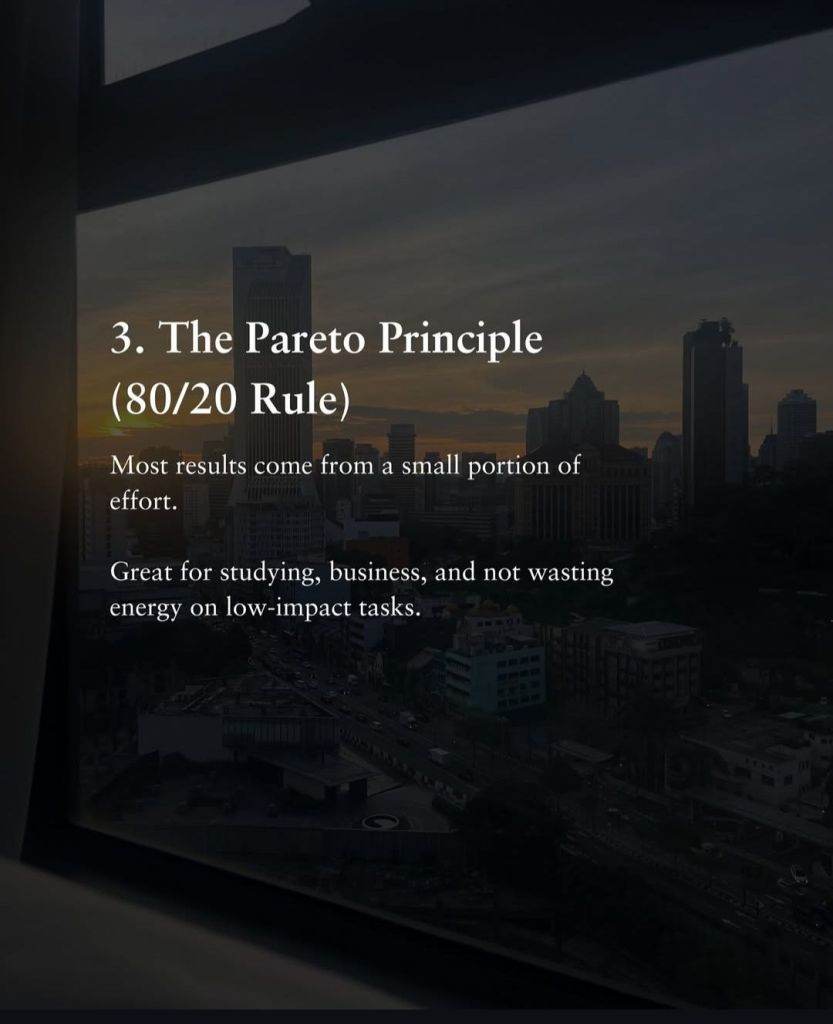


Named after economist Vilfredo Pareto, the Pareto Principle states 80% of results are from 20% of causes which implies only a small amount of the minority is actually driven by the majority. This disproportionate principle is often viewed from the people standpoint, i.e., 80% of the work is completed by 20% of the people. So what about the remaining work and/or people? Well, this is where life is not fair. Equal distribution is a myth, much like the term “balance”.

Businesses would lead us to believe that rewarding the 20% encourages the remaining percentage to do better. No such evidence exists. As some are more motivated by consequences, it is difficult to tell if these are positive or negative consequences. Nonetheless, it can be quite frustrating to be the 20% completing 80% of the work while the remaining workforce contributes little. Wealth distribution was Pareto’s basis for this principle, which relied on statistical tools. Today, many believe the Pareto Principle is manipulated and, therefore, not the universal principle originally touted.

One area where the Pareto Principle is applicable is time management. For example, working for 40-45 mins, then taking a 15-20 min break. Yes, I know it’s not 80/20, work with me here. Most training curriculums mimic this style because studies have shown the attention span is approximately 11 minutes and taking a 10 min break every 60 mins encourages physical and mental reprieve.

I won’t say this one is the most interesting. However, I will say it’s the most common (to me). In a rapidly changing society of differing generational norms, I was raised to work hard, to own my behavior and mistakes, and to strive for the top. It does not seem this way anymore.

More to come!

________________

I ask you –

Without adding “but” or “because”, ask yourself – are you the 80% or the 20%?

(The post Expand Your Mind, pt 3 – The Pareto Principle first appeared here at Running on Fumes.)

© 2026 Running on Fumes
Expand Your Mind, pt 2 – The Dunning-Kruger Effect

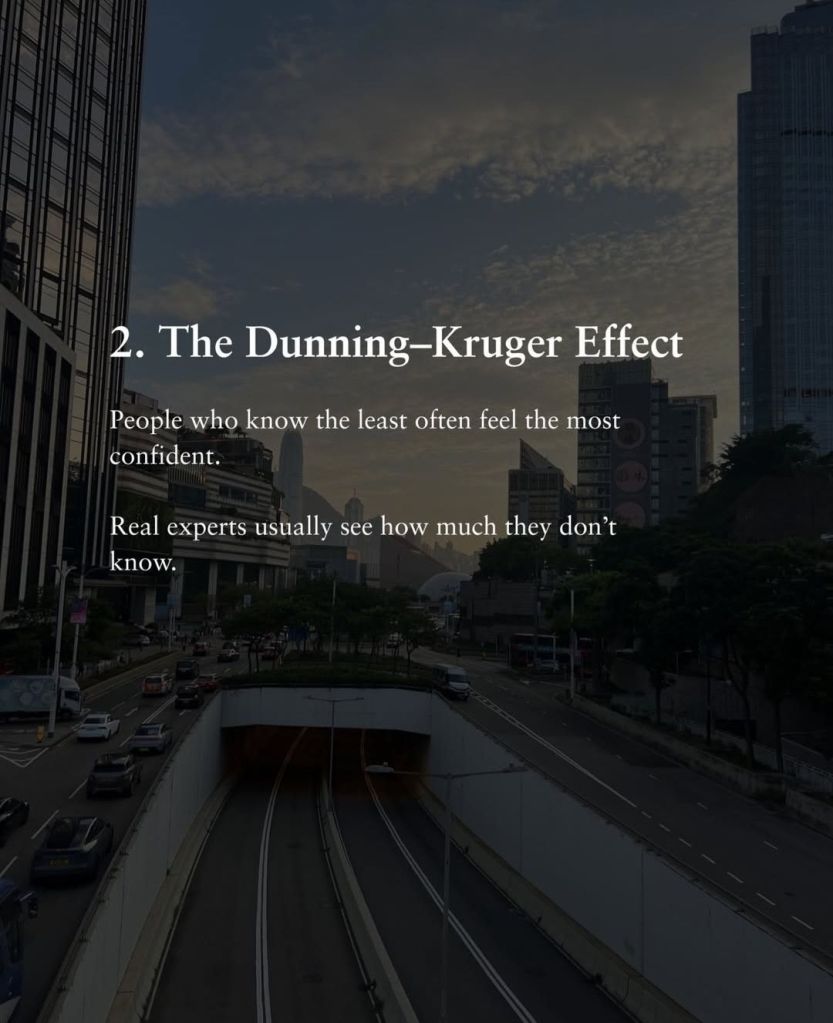
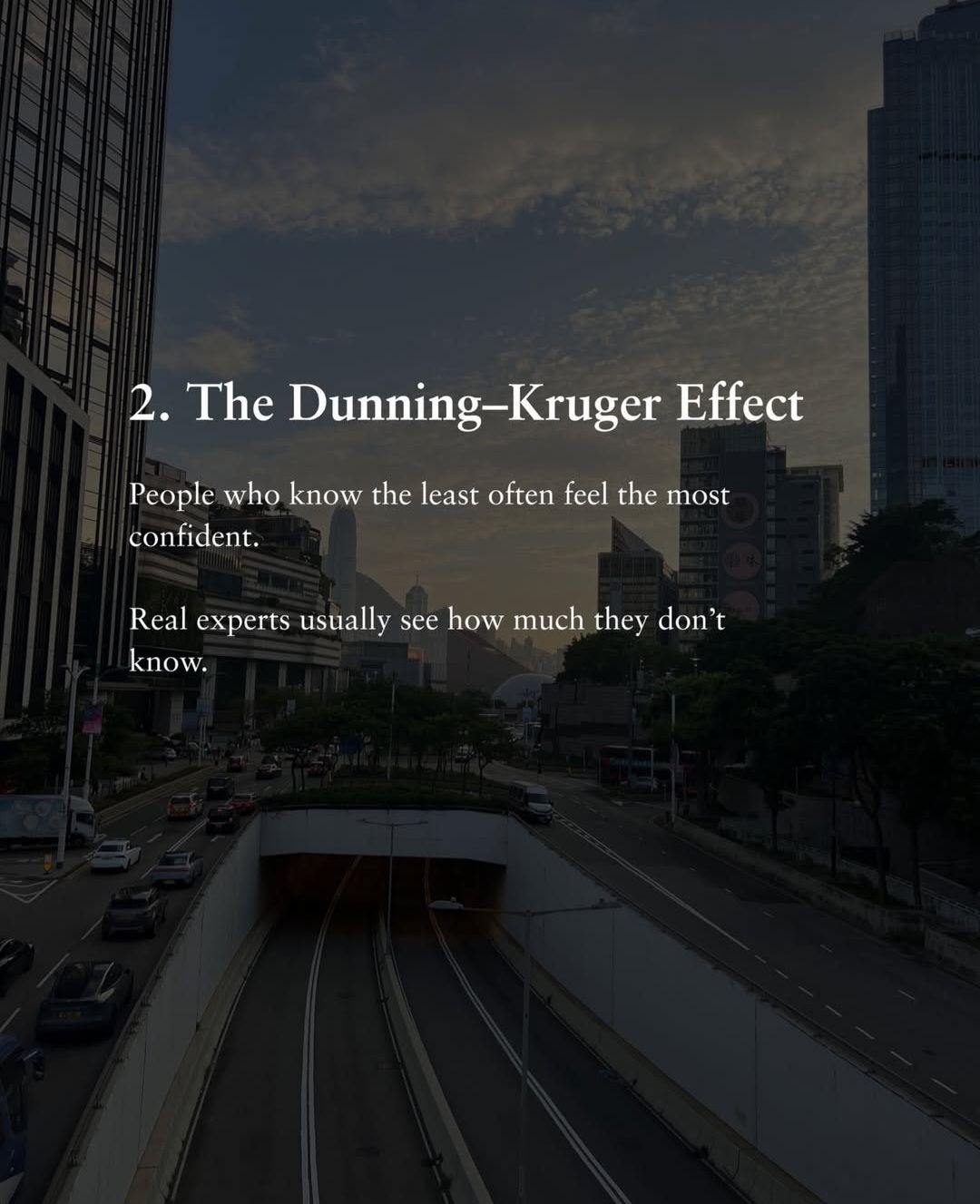
Up next, we have The Dunning-Kruger Effect – the premise is people who know the least often feel the most confident.

Courtesy of IG (janoschgrb)

This particular phenomenon is one of the funniest to me because it posits one’s own incompetence prevents them from recognizing their level of incompetence. Basically, they think they’re smarter than they really are. Don’t we all know someone like this.

It originated in the late 1990s by Dunning and Kruger, psychologists who studied social limitations. This effect opines that a cognitive bias causes a person to overestimate their competence, including painting a comparative picture of believing what comes easily to you must be the same for everyone else. Unfortunately, people experiencing (or portraying) the Dunning-Kruger effect are inherently resistant to change and to being taught what they do not know. Remember, they think they know it already. Bunch of know-it-alls.

This effect mimics the saying “I don’t know what I don’t know”. As seemingly humble as this phrase is, it is a problem when recognizing how to overcome the limitation collides with what is already known. The “self-inflated assessment” of one’s own abilities may lead to mismatched perceptions, evaluations, and merit. Often, the Dunning-Kruger effect is easily recognizable in those who confidently speak about topics they are not masters of.

Notably, children may fall into the trap of believing they are experts after having completed the task/activity/skill once. Upon the next opportunity, when the task does not go as well as it did before, there is a moment of consciousness whereby competence is questioned. “Unskilled and unaware” is how Kruger (1999) described his original research. Hence the loudest voice is not always the wisest.

As far as phenomenon’s go, I actually expected more from this one. Despite knowing many who may be suffering the negative effects of this phenomenon, more worrisome is it seems some don’t know how to fix it or refuse to do so, whereby it simply indicates stupidity.

More to come!

________________

I ask you –

Were you aware of the Dunning-Kruger effect? Perhaps it goes by a different name in your circle?

(The post Expand Your Mind, pt 2 – The Dunning-Kruger Effect first appeared here at Running on Fumes.)

© 2026 Running on Fumes